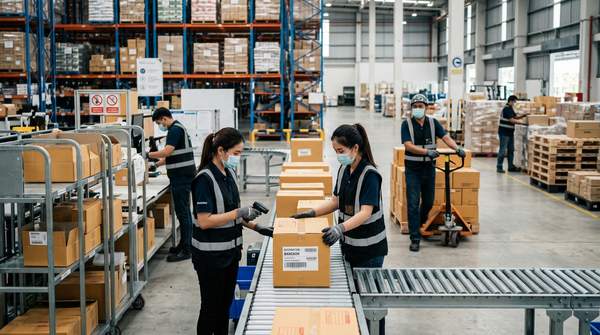
Thousands of remote workers in Costa Rica and India spend nine-hour shifts auditing up to 8,000 video feeds weekly, ensuring Amazon's AI camera systems operate without error. This massive, invisible workforce reveals a new reality: the future of work involves humans performing high-volume, repetitive tasks to validate AI systems.
AI is delivering significant productivity gains and fostering some new employment, but it is simultaneously putting a substantial portion of existing jobs at high risk of automation and creating low-value oversight roles.
Societies are likely to face increasing labor market polarization and a critical need for widespread reskilling initiatives to mitigate the social and economic fallout of rapid AI integration, particularly as AI automation impacts workforce productivity in 2026.
AI's productivity gains? They primarily benefit firms and a select few, pushing much of the workforce into precarious, low-value oversight roles or outright displacement. This isn't some gradual evolution; it's a profound transformation. The benefits concentrate at the top, while the risks scatter across the labor market, creating a dynamic that actively challenges economic equity and stability. And who bears the brunt? Predictably, vulnerable demographics, further cementing existing inequalities. For more, see our AI's Workforce Shift: Will Displace.
The Shifting Landscape of Work
The number of job vacancies in the UK fell to a five-year low in June, according to The Guardian. This drop suggests AI, for all its hype, isn't translating into robust job expansion for everyone.
These remote workers in Costa Rica and India, monitoring Amazon's AI camera systems for nine-hour shifts, screening up to 8,000 videos a week, according to The Guardian, aren't just an anecdote. They embody a new labor reality. The stark contrast between AI's promised productivity boosts (Canberra CityNews) and the emergence of these high-volume, low-value human oversight roles reveals that many companies aren't eliminating jobs outright; they're transforming them into precarious, dehumanizing tasks to validate imperfect AI systems.

Rapid AI adoption disproportionately affects young workers in Korea, according to 조선일보. This means entry-level positions are increasingly vulnerable, creating a bottleneck for new talent. The immediate impact isn't just fewer jobs, but a shift towards precarious, low-value human oversight and a disproportionate burden on younger generations.
AI's Productivity Promise
Workers using generative AI reported saving 5.4% of their work hours in the previous week, according to stlouisfed. This efficiency gain means AI can free up time for other tasks or potentially boost overall output.
Australia is experiencing its most credible productivity boost in almost two decades, largely attributed to AI, according to Canberra CityNews. While displacement concerns persist, AI undeniably delivers significant gains. There was also 2.4% employment growth in full-time, permanent positions, according to oecd. This paints a picture of a complex, evolving labor landscape, not an outright collapse.
Understanding AI's Dual Impact
Individual AI adoption reached 41% by November 2025, according to federalreserve. This widespread personal use means AI tools are becoming commonplace across the workforce.
However, despite this widespread individual AI adoption, a substantial 38.8% of current jobs remain at high risk of automation, according to kdi. This implies AI often augments roles, rather than fully replacing them—for now. The persistent high risk for nearly 40% of jobs suggests a looming wave of displacement that current augmentation efforts are merely delaying, not preventing.
The Federal Reserve states that approximately 18 percent of U.S. firms had adopted AI by year-end 2025, yet also reports that 78 percent of the labor force works at firms that have adopted AI. This implies that the firms adopting AI are predominantly large employers, concentrating AI's impact on a significant majority of the workforce despite a lower overall firm adoption rate. The acceleration of AI integration is far outstripping earlier projections, intensifying its labor market effects.
Navigating the Fragmented Future
By November 2025, 41% of individuals had adopted AI, according to federalreserve, confirming its growing presence in daily professional life. More critically, 78 percent of the labor force works at firms that have already adopted AI, according to federalreserve. This isn't just broad reach; it's a pervasive shift that fundamentally reshapes the employment landscape. However, this widespread integration does not guarantee equitable distribution of benefits or risks. Instead, it suggests a future labor market that will be highly stratified, demanding targeted interventions to prevent a permanent underclass from forming.
The disproportionate impact of AI on young workers means entry-level positions are increasingly vulnerable. This creates a bottleneck for new talent and exacerbates generational economic inequality. Companies like Amazon, with their extensive AI-driven systems, will face continued scrutiny regarding the quality of jobs created versus those displaced by 2026.
Ultimately, if current trends persist, societies will likely grapple with a deeply bifurcated labor market, where a privileged few harness AI for innovation while the majority contend with precarious, low-value work or outright obsolescence.