E-commerce growth is often measured through sales, traffic, customers, and order volume. But for an established online business, another question becomes increasingly important: how efficiently can those orders be fulfilled?
IDEALONE is positioned as an order management and logistics system designed for Southeast Asian e-commerce, with distribution and warehousing solutions that address the operational side of online selling. That focus is particularly relevant as the region's e-commerce market moves into a more competitive phase, where businesses are increasingly concerned with fulfilment execution and margins alongside growth.
Momentum Works reported that Southeast Asian platform e-commerce GMV reached US$157.6 billion in 2025, while describing the industry as shifting toward greater control over fulfilment and profitability.
For merchants, this means operational efficiency deserves as much attention as sales growth.
More Orders Do Not Automatically Mean Better Results
Increasing order volume sounds positive, but every order carries an operational cost.
Someone needs to process the order, allocate inventory, pick and pack the product, prepare it for distribution, and deal with any issue that arises along the way. There may also be storage, handling, delivery, return, and customer-service costs associated with the transaction.
If those activities are poorly coordinated, additional sales can increase workload and costs faster than revenue.
This is why e-commerce businesses need to look beyond gross order numbers. A growing business should also understand what happens between checkout and successful delivery.
The objective is not simply to process more orders. It is to process them in a way that supports a sustainable operating model.
Manual Work Can Become an Invisible Cost
Manual processes are not inherently bad.
When an e-commerce business is small, a founder or a small operations team may be able to monitor orders directly. A spreadsheet, inbox, marketplace dashboard, and messaging application may be enough to keep daily activities organized.
The problem occurs when the business grows but the operating process remains essentially unchanged.
Employees may have to copy information between systems, check multiple order sources, reconcile inventory, confirm warehouse instructions, and investigate discrepancies. None of those tasks necessarily generates additional revenue, yet they consume time.
As order volume increases, the cumulative cost can become significant.
A more organized order management environment can help reduce unnecessary repetition by bringing important operational information into a more coordinated workflow.
Inventory Decisions Affect Profitability
Inventory is another area where operational control and profitability intersect.
Too little inventory can lead to missed sales or cancelled orders. Too much inventory can tie up capital and increase storage requirements.
The challenge becomes more complicated when products are sold through several channels or stored in multiple locations.
A product might be available on a marketplace, a direct-to-consumer website, and another sales channel at the same time. If inventory information is not synchronized effectively, businesses can struggle to understand their true available stock.
Recent industry analysis has identified inventory mismatches and fragmented systems as significant challenges for e-commerce businesses scaling across Southeast Asia.
This is why inventory should not be viewed purely as a warehouse issue. It is also an order-management and commercial issue.
The Cost of an Incorrect Order
An incorrect order creates more than an isolated fulfilment problem.
The business may need to arrange a replacement, process a return, issue a refund, pay additional delivery costs, and respond to customer-service inquiries.
There can also be a less visible consequence: the customer may become less likely to order again.
That makes order accuracy an important operational objective.
Technology cannot guarantee that mistakes will never occur, but a connected process can help businesses establish clearer information flows and reduce the need for employees to work from conflicting records.
The goal is to make the correct process easier to follow.
Warehousing Has a Direct Commercial Impact
Warehousing is sometimes treated as a back-end function that has little connection to revenue.
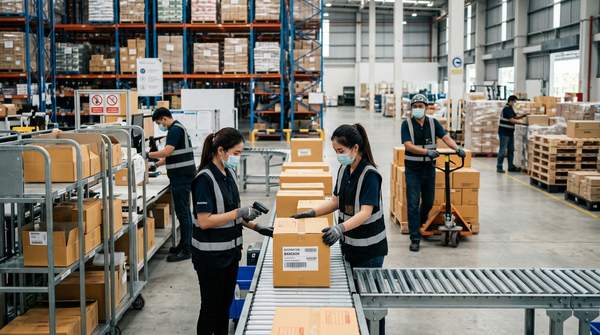
In reality, warehouse efficiency can affect how quickly products become available for sale, how accurately orders are fulfilled, how much stock is tied up in storage, and how quickly completed orders enter distribution.
As Southeast Asian e-commerce becomes more sophisticated, fulfilment infrastructure is receiving greater attention. Market research indicates that warehousing and fulfilment are expected to remain growth areas within the ASEAN e-commerce logistics market.
For merchants, that makes warehouse processes worth examining alongside the storefront and marketing strategy.
An attractive online store can generate demand, but the warehouse ultimately has to support the promise made to the customer.
Distribution Costs Need Context
Delivery is another major component of e-commerce economics.
A business may have several possible ways to move an order from warehouse to customer. Costs can vary according to distance, destination, parcel characteristics, delivery speed, and local logistics conditions.
Southeast Asia adds further complexity because markets differ significantly in geography and infrastructure. An approach suitable for a dense urban environment may not be appropriate for an archipelagic or more geographically dispersed market.
This means businesses need visibility into their distribution operations rather than treating shipping as a single fixed cost.
A logistics system can help create a more structured operational environment in which order and distribution information are considered together.
Returns Can Change the Economics of an Order
A completed sale is not necessarily the end of the transaction.
Customers may return products because of damage, incorrect items, sizing issues, changed preferences, or other circumstances. The business then has to manage the product's movement back through the supply chain.
McKinsey has identified returns as an increasingly important component of Southeast Asian e-commerce logistics, noting that a better return experience can influence customer purchasing behavior.
Returns therefore need to be considered when evaluating fulfilment efficiency.
A business that focuses exclusively on outbound delivery may overlook the operational cost of getting products back, assessing them, updating inventory, and resolving the customer's request.
Better Visibility Supports Better Decisions
Operational visibility does not automatically make a business more profitable.
What it does is provide information that can help decision-makers understand where money, time, and resources are being consumed.
For example, a business may discover that certain products generate frequent fulfilment issues. Another may find that inventory is distributed inefficiently between locations. A third may identify excessive manual work around specific order channels.
Without organized information, these patterns can be difficult to see.
This is one reason modern e-commerce operations increasingly treat data and technology as part of the business infrastructure rather than simply administrative tools. Maersk has noted that e-commerce fulfilment is requiring increasingly granular visibility into individual parcels and stronger data infrastructure.
Regional Growth Makes Control More Important
The need for operational control becomes more apparent when a business expands.
Entering another market can introduce additional inventory locations, sales channels, warehouses, carriers, and customer-service requirements.
The business may still have the same core objective — sell products and fulfil orders — but the number of variables increases.
This is where a regional order management and logistics system can become relevant.
IDEALONE's positioning around Southeast Asian e-commerce reflects the importance of designing operational processes around a region where market conditions can vary substantially.
The objective should not be to force every market into an identical workflow. It should be to establish a coherent operating structure that can accommodate legitimate differences between markets.
Profitability Requires More Than Sales Growth
E-commerce businesses naturally focus on acquiring customers and increasing sales. But once the operation reaches a certain scale, the quality of fulfilment becomes an important part of the commercial equation.
Orders need to be processed accurately. Inventory needs to be managed carefully. Warehouse activity needs to support demand. Distribution needs to be coordinated. Returns need to be handled efficiently.
Each of these processes can affect the economics of the overall business.
That is why order management and logistics deserve attention at the leadership level rather than being treated solely as administrative functions.
Building an Operation That Can Support Growth
The strongest e-commerce operations are not necessarily the ones with the most complicated technology.
They are the ones in which technology supports clear processes.
Businesses should understand where orders originate, how inventory is allocated, how warehouses fulfil demand, how distribution is organized, and what happens when something goes wrong.
IDEALONE's role within this landscape is its positioning as a system connecting order management with logistics, distribution, and warehousing for Southeast Asian e-commerce.
For businesses focused on sustainable growth, that connection is worth considering.
Revenue growth creates opportunity, but operational control determines how effectively a business can convert that opportunity into a repeatable and sustainable customer experience. As Southeast Asian e-commerce becomes more competitive, understanding the economics behind every order may become just as important as generating the next one.