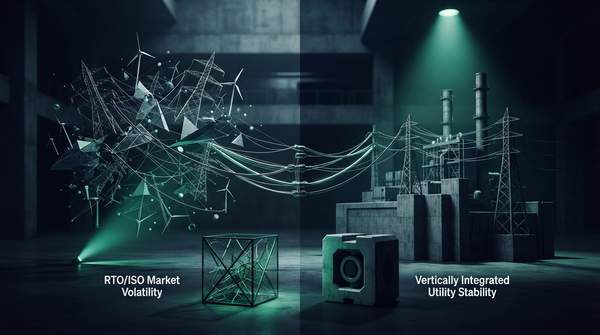
The United States organizes wholesale electricity under two fundamentally different governance models, and the choice between them determines who makes investment decisions, which stakeholders can shape outcomes, and who loses money when forecasts prove wrong. In restructured regions, independent system operators and regional transmission organizations run competitive wholesale markets governed by independent boards with extensive stakeholder input, while in vertically integrated states, utilities build generation and recover approved costs through regulated rates under state utility commission oversight. Understanding these two structures—and the trade-offs between broad participation and centralized control—is essential for policymakers weighing market reform.
Introduction to U.S. Wholesale Electricity Market Governance
The National Governors Association frames the central divide in U.S. power markets as the difference between vertically integrated and restructured electricity markets, with RTOs and ISOs serving as the operating and governance institutions in restructured regions. The Environmental Protection Agency notes that these organizations were formed in response to two Federal Energy Regulatory Commission orders, and that they are intended to foster competition, guard against market manipulation, facilitate grid planning and operations for reliability, and guarantee that all types of power suppliers have access to the grid.
The reach of the restructured model is substantial: according to the EPA, about two-thirds of U.S. electricity consumers live in a region where transmission is managed by an ISO or RTO. The remaining consumers are served largely under the traditional vertically integrated model, in which a single utility owns generation, transmission, and distribution, and state regulators approve its investments and rates. These are general models; governance varies across individual RTOs, and this comparison does not address retail prices or specific market performance metrics.