Customs agencies are turning to artificial intelligence for two jobs above all: catching fraud and inspecting cargo. A regional survey by the United Nations Economic and Social Commission for Asia and the Pacific (ESCAP) found AI is most used for fraud and smuggling detection and for cargo inspection through image analysis, with customs administrations well ahead of other government agencies in applying AI to trade. But the same survey shows adoption is deeply uneven. East and North-East Asia exceed 50% in implementation and readiness; Pacific Island developing economies sit below 10%.
AI in Customs: Balancing Trade Facilitation and Supervision
Why the rush toward AI at all? Because customs faces a structural conflict. Writing in the World Customs Journal, Quan Cao and Xia Zheng describe a tension between "supervision" and "facilitation": enterprises want fair competition, lower trade costs and assured trade quality, while governments need border security and compliance. The two goals pull in opposite directions.
AI is attractive precisely because it promises to serve both at once. The authors' study of China Customs' intelligent inspection application concludes it addresses the core challenge of balancing regulation and facilitation — combating smuggling, securing borders, improving the business environment and strengthening supervision capacity simultaneously.
There is a second driver: corruption risk. Guidance from the World Customs Organization and the International Monetary Fund explicitly links reducing human interaction at borders with lower corruption risks, including through automation and AI-assisted risk analysis, according to ESCAP's analysis of AI agents in trade. Many of the tasks that slow clearance — repetitive, cross-system administrative work — do not require legal discretion, making them natural candidates for automation.
Key AI Applications in Customs Operations
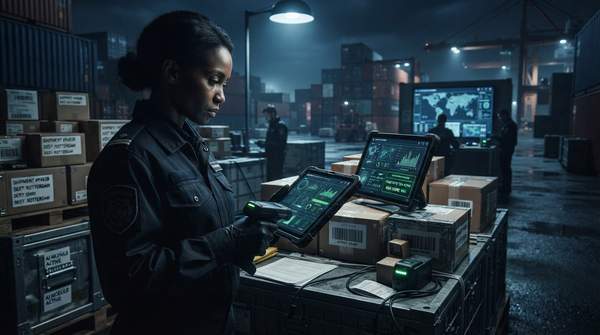
The ESCAP survey of Asia and the Pacific identifies the operational front-runners. Fraud and smuggling detection tops the list, followed by cargo inspection and image analysis. Customs agencies use these systems to analyze large volumes of data and imagery, flagging anomalies that may indicate smuggling or misdeclaration.
UNCTAD's trade facilitation training material points to a broader set of use cases: risk management, pre-arrival processing, inspections and post-clearance audit. Notably, the ESCAP survey finds the use of AI for predictive analytics in trade operations remains very limited — the frontier is narrower than the hype suggests.
East and North-East Asia leads in operational use, at 41% versus a 15% average across other sub-regions. That gap is not just about technology; it reflects who has the data, infrastructure and skills to run AI systems at all.
AI in Customs: Applications, Challenges, and Readiness
The table below maps the documented applications to the challenges that most directly constrain them, drawing on the ESCAP survey, the World Customs Organization's report on AI adoption in customs, UNCTAD's implementation guidance and PECC's analysis of AI for trade facilitation in the APEC region.
| AI Application | Key Implementation Challenge | Regional Readiness Impact |
|---|---|---|
| Fraud and smuggling detection | Depends on data quality, infrastructure and human skills — foundational prerequisites many countries are still establishing | East and North-East Asia exceed 50% adoption; Pacific Island developing economies remain below 10% |
| Cargo inspection and image analysis | Requires robust digital connectivity and computing power to process large volumes of image data | Advanced economies run AI inspection at scale; others are still building basic capabilities |
| Trade facilitation and compliance | Skills gap: officers, policymakers and decision-makers need data literacy to interpret AI-generated insights | Collaborative forums are suggested to narrow the divide between emerging and advanced adopters |
The pattern is consistent: the most valuable applications are the most demanding. Fraud detection needs clean data and skilled staff. Image analysis needs computing infrastructure. Neither arrives automatically.
Navigating Implementation Challenges for AI Adoption
The World Customs Organization's detailed report on AI and machine learning adoption is blunt about what comes first: technical expertise, built through structured training, collaboration with external experts and hands-on experience. Beyond that, customs administrations need a culture of data literacy — the ability to understand and interpret data — across technical and non-technical staff alike. Officers and decision-makers must be trained to interpret AI-generated insights and apply them in decisions.
UNCTAD frames the adoption question practically: consider the infrastructure, data and skills needed to identify where AI can realistically add value in your country or organization. Responsible implementation also demands attention to privacy, transparency, governance and human oversight.
PECC's analysis adds a cost dimension. For economies at earlier stages of digital development, the most practical path is maximizing access to cloud services on a pay-as-you-go basis for cost-efficiency — a different strategy than building owned infrastructure.
The Global Digital Divide in AI Readiness
PECC describes the regional picture as two realities held simultaneously: a small cohort of advanced economies operating AI systems at scale, and a larger group still putting in place the foundational prerequisites of any AI application. AI itself is not new to trade facilitation — customs administrations were deploying classical machine learning and natural language processing long before generative AI emerged.
The ESCAP survey quantifies the divide. East and North-East Asia exceeds 50% in implementation and readiness; Pacific Island developing economies lag below 10%. PECC suggests collaborative forums as one mechanism to reduce the gap between emerging and advanced adopters, and its analysis argues policy responses must be calibrated to each economy's level of readiness rather than applied uniformly.
Navigating the Future of AI in Customs
The evidence points to a clear priority sequence. Customs administrations and trade professionals should prioritize investment in foundational digital infrastructure, data quality and human skills development to effectively leverage AI for both trade facilitation and robust supervision. The technology is the easy part; the foundations are the bottleneck.
For trade professionals, the practical takeaway is to assess where their own operations and counterpart agencies sit on the readiness spectrum. The measurable indicator to watch is increased regional collaboration and targeted capacity-building initiatives, particularly in lagging regions, alongside measurable improvements in data governance frameworks. Where those appear, the applications documented in the ESCAP survey — fraud detection and cargo inspection first — become realistic. Where they do not, AI in customs remains a regional privilege rather than a global standard.
Sources
- Artificial intelligence in trade facilitation in Asia and the Pacific — Repository
- Application of Artificial Intelligence Technology in the Supervision of Customs Clearance Machine Inspection — Worldcustomsjournal
- WCOOMD
- From AI to AI agents for trade facilitation: Getting ready — ESCAP
- Harnessing AI for Smarter Trade Facilitation — UNCTAD Trade Facilitation E-Learning
- PECC